
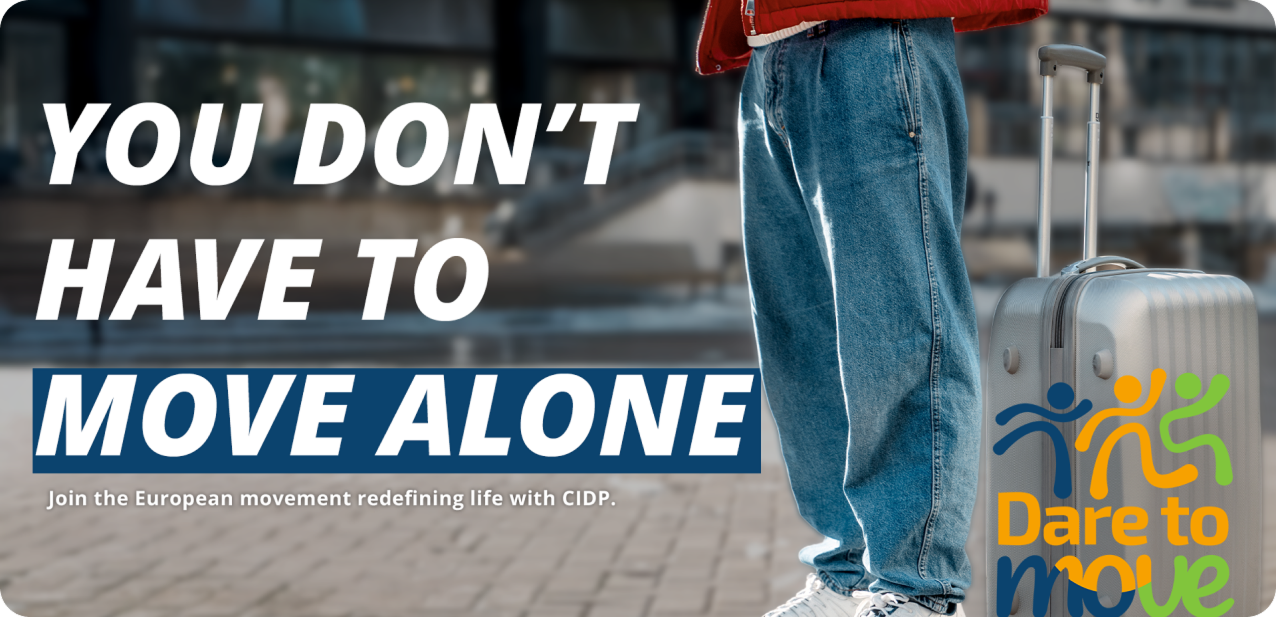

Dare to Move:
Join a community that gets it
Living with CIDP means facing daily questions: How do I adapt my home? Can I still work? What is going to happen?
The answers aren’t always in a medical textbook; they are in the lived experience of others.
Dare to Move brings together people across Europe to share practical advice, lived experiences, and real-life ways of navigating mobility challenges day by day.
From June 2026 onwards, the initiative will unfold through public awareness activations, patient stories, and discussions culminating in European roundtables in Brussels this September.
Be part of the conversation and subscribe to receive updates, activities, and key outcomes from the initiative.
The reality behind the acronym CIDP
For people living with CIDP, mobility is far from guaranteed. This severe autoimmune disease occurs when the immune system attacks the peripheral nerves, causing progressive muscle weakness (1,2). The impact on daily life is profound:
62%
struggle to walk outdoors or are unable to do so at all. (3)
82%
see their social life affected by the condition, often leading to isolation. (4)
29%
rate their mental health as “poor” or “fair” (3).
Listen to the voices breaking the silence
They declared me completely incapable.
Alejandra
Living with CIDP

COMING SOON
A dedicated platform
for people living
with CIDP
Be the first to know
We know that "just rest" isn’t always the answer.
That’s why we’re currently building a new website dedicated to practical, lived-experience advice.
From adapting your nutrition to managing fatigue at work, we are curating guides written by and for people who know exactly what it feels like. You will also find authentic stories and testimonies from the ones directly affected by CIDP, as well as useful community resources.
Want more great content?
Follow us on social media.



Subscribe to the newsletter
By clicking the "Sign Up" button, you consent to sign up for our “Newsletter” and to receive communications from argenx, its affiliates, and companies working with argenx. These communications may include updates, newsletters, event invitations, and other information related to CIDP (chronic inflammatory demyelinating polyradiculoneuropathy), our campaigns, and initiatives, and may be sent via email or other electronic devices. We value your privacy and will not share your personal data with third parties without your explicit consent. You can unsubscribe from our emails at any time by clicking on the "unsubscribe" link in the footer of our emails or by contacting us directly at privacy@argenx.com.
For more information about our privacy practices and how we handle your information, please see our Privacy Policy and Cookie Policy.
Please be aware that this mailing list is intended for European residents only.
 Thank you for signing up!
Please check your inbox and click the confirmation link to activate your CIDP United newsletter.

References
- Johns Hopkins Medicine. Available at: https://www.hopkinsmedicine.org/health/conditions-and-diseases/chronic-inflammatory-demyelinating-polyradiculoneuropathy (last accessed May 2026)
- WebMD. Available at: https://www.webmd.com/brain/what-is-cidp (last accessed May 2026)
- Paci S et al. CIDP patients’ health-related quality of life, daily activities and fatigue: results from a multinational real-world survey. argenx BV, Services in Health Economics (SHE) BV, Adelphi Real World; 2025.
- Adelphi CIDP DSP Real World Evidence Generation, June 2024.